
Before the Conference Room, There Was the Campfire
One fire, one weekend, three conversations.
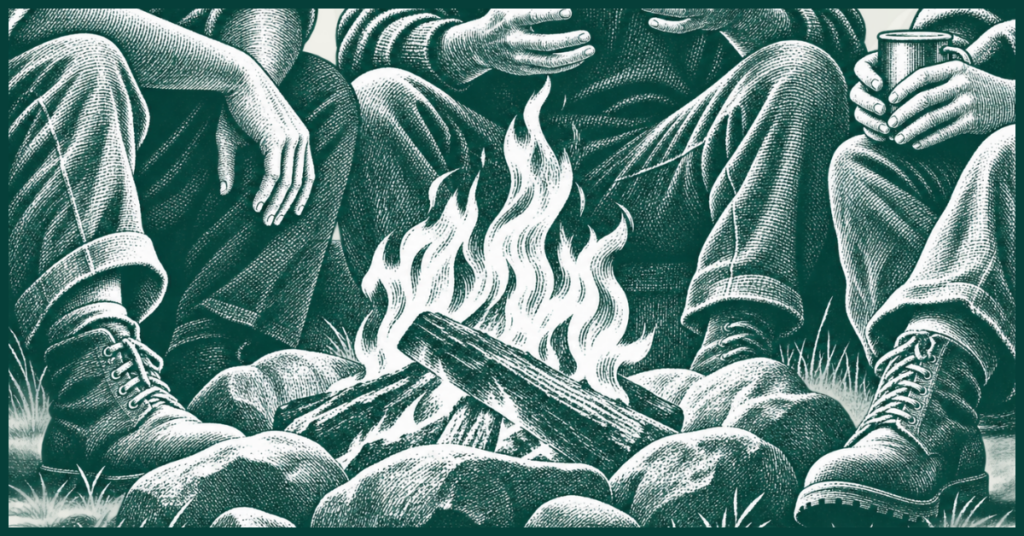
Same Fire, Different Conversations
For nine years, I served as “Navigator” for my kids’ YMCA Guides groups. Roughly 15 dad/daughter or dad/son pairs load up and caravan out for a weekend campout of hiking, whittling sticks, and lakeside grilling.
Upon arrival at the campsite, the dads’ first job is to get the campfire started. It will burn all weekend. During the day, it serves one logistical purpose: orientation. The fire is where we meet and regroup. It’s where we reapply sunscreen, decide what the next activity will be, or grab a snack.
At night, however, the fire sheds the costume of practicality and becomes a place of connection. We make s’mores and share stories with each other about what we did that day. How fast we went on the zipline. The size of the raccoon we saw or the fish we caught. And when the kids can hardly keep their eyes open anymore, the final bedtime story. Usually it’s one with a moral. Like the bundle of twigs that isn’t easily broken, or the blindfolded scout who sits alone in the forest for one full night, only to learn his father was right beside him all along.
When the kids are asleep in tents or the cabin, the fire transforms again. The dads share stories about our lives. We talk about what’s going on at work. In our homes. The pride we take in our kids, and the concerns we have about what the next stage holds.
Oh, and also we keep talking about the size of the fish we caught.
Nobody schedules any of it. The sun sets, the kids fall asleep, and the talk changes on its own. I always figured that was just what campfires do. It turns out an anthropologist measured it.
Six Percent by Day. Eighty-One Percent by Night.
Polly Wiessner, an anthropologist at the University of Utah, has studied the Ju/’hoansi of Botswana and Namibia since the early 1970s. In 1974 she recorded what they talked about, by day and by firelight, across 174 conversations. She calls the study exploratory. It’s one people, in one place.
By day, about a third of the talk was complaint, criticism, and gossip, the running ledger of who owed what. Another third was economics: foraging plans, hunting strategy. Jokes took most of what was left. Stories were the 6 percent.
At night, around the fire, 81 percent of conversations involved stories, often about people everyone knew. Complaints fell to 7 percent. Economics fell to 4.
Same people. Same day.
On our campouts, the daytime fire is the economic third: where we meet, what’s next. The evening fire and the late fire are the 81 percent, stories about people we know. I didn’t know the numbers, but I’d been watching them for nine years.
Night talk mended the day’s friction and carried the big picture of how their world worked. By day, Wiessner finds, the clock ran the conversation. By night, the conversation ran the clock.
The Sun Never Sets in Business
The conference room is the daytime hearth. Status, logistics, who’s behind, what’s blocked. Somebody has to plan the hunt.
Fire was technology too, one of the most consequential humans ever adopted. Among the things it bought was a different kind of hour.
Then a night job lands on the calendar. A strategy people need to believe. A change that will cost them something. A vision of something that doesn’t exist yet. We book it into the same room, under the same lights, with the same screen at the front and the same hour the budget review gets. People answer in day mode: questions about logistics, an inventory of how it’ll impact them, polite nods.
The conditions decide what kind of conversation is possible.
The late fire proves it. Those dads are grown adults with jobs, the same people who sit in conference rooms all week. And work inevitably comes up. It appears as stories about our lives, because the kids are asleep, the dark has closed in, and no one’s running an agenda. It’s the same subject as Monday’s meeting, but a completely different conversation.
Most of us already know what a good gathering feels like. At work, we kept the daytime and lost the night.
Name the Job Before You Book the Room
We all run plenty of day-talk meetings, and most of them should stay that way. The trick is catching the night-talks before they become calendar invites.
Name the job. For each meeting that matters, ask whether it’s coordinating work (who, what, when) or asking people to believe, commit, or change.
Give day jobs better day talk. Shorter, sharper, maybe a slide or two (no shame). That’s what day talk is for.
Give night jobs new conditions first. Borrow them from the firelight:
A smaller circle. Wiessner’s firelight gatherings ran up to about 15 people. Keep yours to people who can hear each other without a microphone.
The agenda off the wall. When a screen is the focal point, the conversation follows the slides.
A story about someone they know. Bring your audience on a journey about a customer, a colleague, or a victory from last quarter.
A fire gives people a reason to stop moving. It offers light in the darkness. It focuses attention on what’s in the circle and lets everything outside it fade.

Which Fire Is Your Next Meeting?
Which meeting on next week’s calendar asks people to believe something?
What would happen in that meeting if the screen stayed dark?
Who belongs in the smaller circle?
“Foragers make use of daytime efficiently and nighttime effectively.”
keep readingMore from Life After Decks
All issues →


putThe Campfire Method to work
- One reader
A deeper look at how leaders move important ideas from understanding to belief to action.
Get the book → - One leader
Six weeks of focused support for a leader preparing for a high-stakes moment.
Explore the Presentation Sprint → - One team
A one-day experience for leadership teams to build stronger skills for selling complex, high-stakes ideas.
Plan a Campfire Method Workshop → - One company
For organizations that want a shared method for how important ideas travel.
Explore Enterprise Storytelling →