
A Blog with Tips & Tricks for Enlightened Presenters

The Presentation Paradox

The Paradox Nobody Talks About
We mapped out the actual, messy, adrenaline-soaked reality of what happens when we need to sell an idea that matters.
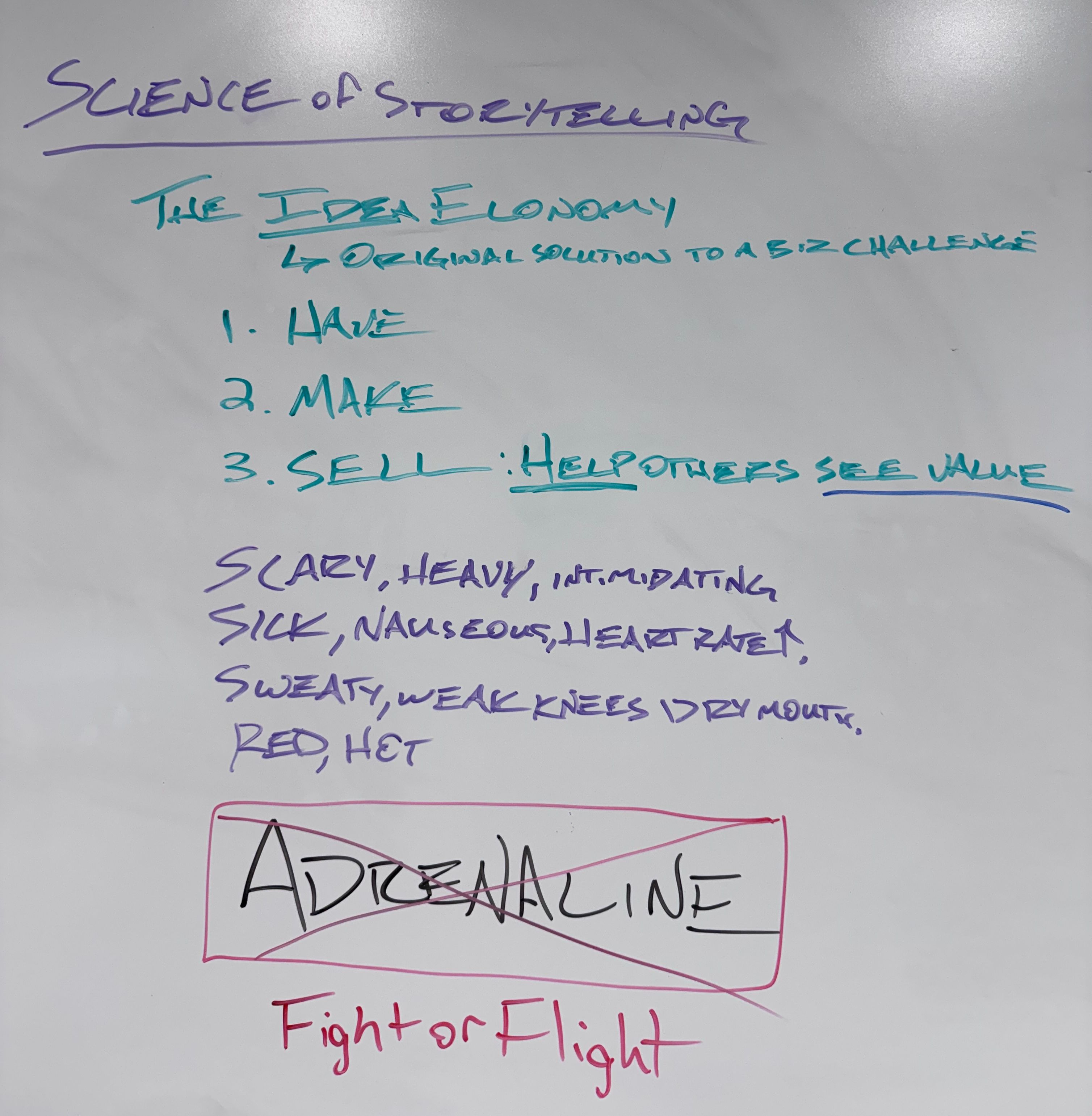
Here’s what we know to be true:
It’s an idea economy. Nothing in business happens unless someone offers a solution to a challenge. No matter how brilliant you are at execution, nothing moves forward without someone saying yes to an idea first.
We have three responsibilities to ideas:
-
To have them.
-
To make them happen.
-
And to sell them, or to communicate so we might help others see their value and choose to believe.
But here’s where it gets uncomfortable.
Your Brain Thinks You’re Being Chased
Selling an idea is difficult. Our bodies see a high-stakes presentation as a threat. When we step into that conference room or onto that stage, our amygdala (the brain’s alarm system) perceives social evaluation as danger. So our bodies flood with adrenaline, the same hormone released when we’re being chased by a bear, or criticized by a coworker. Research on public speaking consistently shows levels spiking approximately 60% above baseline when people present, with peak stress occurring about 30 minutes into the experience.
This makes us scared. Nervous. Sweaty. Our hearts race, our breathing becomes shallow, and our working memory, the very thing we need to think clearly, gets hijacked. We experience the full fight-or-flight response, except we can’t fight our audience and we can’t run out of the room.
Plot Twist: They’re Freaking Out Too
But here’s what we don’t talk about enough: our audience is ALSO governed by adrenaline in these moments.
When we show up and start throwing slides at people, their nervous systems have a choice to make. They’re not interested in the cognitive load we’re asking them to take on. In fact, research on cognitive load theory shows our working memory can only hold 3-5 chunks of new information at once. And when presenters overload slides with text, read aloud what’s written, or present complex diagrams alongside dense information, audiences absorb almost nothing.
A 2018 study tracking eye movements during presentations found when slides contained multiple long-form bullet points, audiences read only a fraction of the content. When slides combined text and complex diagrams, engagement dropped so severely that almost nothing was absorbed at all. The same study found 95% of business professionals multitask during meetings, with one-third losing track of what’s being discussed and one in five making errors in their work because of it.
We’re not just boring them. We’re triggering the wrong chemistry in their brains.
Adrenaline is our common enemy. Presenter and audience, united against the same fickle mistress of a villain.
The Reflex That’s Killing Our Chances
And yet, we turn to the familiar for comfort. The slide deck. The friendly conference room. The assumptions about our audience. The habits that “got us here,” so surely they can “get us there.”
These defaults, these unexamined habits, are destroying our ability to serve our ideas with the respect they deserve. Worse, they’re adding fuel to the fire. They increase adrenaline in both presenter and audience, creating a vicious cycle where nobody wins and good ideas die in rooms where they should have taken flight.
The Only Thing That Actually Works
But there’s hope.
The only thing that’s been proven to neutralize adrenaline, paint a picture of the future state, and help an audience see what’s in it for them is story.
Not prettier decks. Not formal training. Not flashy, indulgent charisma.
Time-tested, familiar, relatable story.
Neuroscientist Paul Zak’s research demonstrates when people hear a compelling narrative—one that follows a dramatic arc with tension, stakes, and resolution—their brains release oxytocin, the neurochemical associated with empathy, trust, and connection. His studies show that emotionally engaging narratives don’t just create feelings; they inspire post-narrative actions. People who watch story-driven content with a clear dramatic arc show measurable increases in oxytocin and are significantly more likely to take cooperative action afterward.
In one study, participants who watched a narrative about a father and his dying son showed increased oxytocin levels that correlated directly with their feelings of empathy, and those participants then chose to send money to a stranger. The control group, who watched a “flat” version of the same story without narrative structure, showed no oxytocin increase, reported no empathy, and took no action.
Stories change brain chemistry. They transform threat into connection. They make belief possible.
Getting It Right
One of our clients, a healthcare officer, was preparing for the most important meeting of her career. She was presenting a new patient care initiative to the executive team. She’d built a 47-slide deck. Every stat. Every data point. Every objection anticipated and addressed.
Then she stopped and thought about what her idea actually deserved.
She threw out the deck. She took the stage and told three stories, each of a different patient journey. Each story built on the last, showing the human cost of the current system and the human benefit of her proposed change.
The executive team leaned in. They asked questions. They felt something. And when she finished, they didn’t ask for the data. They asked when they could start.
That’s what happens when you choose story over slides. When you give your idea the respect it deserves.
What This Means Monday Morning
The next time you get invited to present, notice your reflex.
Before you open PowerPoint, ask yourself: Does my idea need slides, or does it need story? Does it need information transfer, or does it need belief?
Your audience’s nervous system is already making that choice. The only question is whether you’ll design for the chemistry that creates connection, or default to the habit that triggers threat.
I believe your ideas can change the world. But they can’t change anything if they die in a conference room because you defaulted to slides when your idea deserved a story.
That’s why I do what I do.
Your ideas deserve better than autopilot. If you’re working on something that needs buy-in to have a chance at changing someone’s world, and you’re ready to redefine your relationship with presentations, we should talk.
Let’s make sure your best ideas get the chemistry they need to win.
“Stories are powerful because they transport us into other people’s worlds but, in doing that, they change the way our brains work and potentially change our brain chemistry—and that’s what it means to be a social creature.”
🔥 Hi, I’m Eric, and every week, I share insights, observations and tools so you can ditch decks and light a fire in your high-stakes presentations. If you like what you see here, follow me on LinkedIn.