
A Blog with Tips & Tricks for Enlightened Presenters

Other People’s Scars
Other People's Scars
The advice is real. The experience behind it isn't yours.

Eric Harris
April 03, 2026

She Knows Her Material Cold
Alex stands at the front of the room, twelve pairs of eyes anxiously glued to her.
She has prepared for this. She has over-prepared for this. She knows the data, the stakeholders, the counterarguments. She has a slide for every possible question and a backup slide behind that.
She opens her mouth. Everything comes out the way it sounded in her head.
And yet, when she’s finished, no one moves. All twelve audience members go on about their day, as though they’d never come in contact with her or her idea.
She’s 34 years old. She has been presenting for over a decade. And she has never felt more lost.
Here's how she gets here.
Year One: Do Your Homework
Alex's first real manager is a woman named Diane. Diane gets burned once, badly, in a presentation setting. She enters a room full of executives without knowing two of them have a history, the budget conversation is already poisoned, and the whole meeting is theater.
She never makes that mistake again.
"Do your homework on the room," Diane admonishes Alex. "Know who’s there."
Alex takes it seriously. She pulls LinkedIn profiles. She learns org charts. She catalogues titles, tenure, and reporting lines. Before every presentation, she can give you the professional biography of everyone in the room.
What she can't give you: what keeps them up at night. What they're hoping she'll say. What they actually need from her, that day, in that room.
She has a map. She hasn’t walked the streets. But Diane's advice feels complete, so Alex never thinks to dig deeper.
Year Four: Parlor Tricks
A mentor named Robert takes Alex under his wing. Robert is an engineer turned executive. He learns to present the hard way, through a thousand painfully literal slide decks, and he cracks what he believes is the code.
"Tell them what you're going to tell them," he says. "Tell them. Then tell them what you told them." He leans back, arms crossed, satisfied. "Works every time."
A few months later, a different mentor named Carol adds a layer. "The real trick," Carol says, lowering her voice like she's passing along a secret, "is to make them think it was their idea."
Alex nods at both of them. She builds tighter decks. She structures every talk around Robert's formula and engineers the conclusion toward Carol's outcome. Her presentations are logically airtight.
They’re also soulless. Accurate. Forgettable.
Nobody tells her how to make someone feel something. The formula has an architecture. It doesn't have a heartbeat. But it sounds right, so she keeps building decks that way, deck after deck after deck.
Year Seven: Emulate Others
By now, Alex has collected a wardrobe of instructions about herself.
"Be more confident." From a director who means it kindly.
"Don't over-rehearse, it shows." From a charismatic colleague who has never needed an hour of practice in his life.
"Watch how Maya does it." From a manager who loves Maya's style and has no particular language for why, just that it works.
Alex watches how Maya does it. She tries on the posture, the pacing, the way Maya lets silence sit without filling it. It looks effortless on Maya. On Alex it looks like an impression of someone being effortless.
She has been given a series of mirrors, each one reflecting a different version of who she should be. None of them reflect her.
The advice isn't wrong. It's autobiographical. Every person who shares it passes on their own formative critique, their own stumble, their own scar. Diane's scar is walking into an ambush. Robert's scar is a room full of glazed eyes. Carol once loses a deal because someone else takes credit. The colleague who says don't over-rehearse gets told once, years ago, that he sounds stiff. Maya's confidence is the answer to someone telling her she's too quiet.
None of them are wrong. None of them are Alex.
Year Eleven: Untouched
Alex is a leader now. She walks into rooms, presents in rooms, and leaves rooms exactly the way she finds them.
Not because she's lazy. Because it never occurs to her that the room is hers to shape. Nobody ever tells her the lighting matters. The seating arrangement sends a signal before she says a word. A presentation at 4pm on a Friday in a windowless conference room is a fundamentally different presentation than the same content delivered where and when people feel awake and human.
She accepts whatever space is available. She fires up the default slide template. She skips the rehearsal because she's busy and knows the material. She fills in what she thinks she knows about the audience and calls it research.
She doesn't know she's doing any of this. These aren't choices. They're habits. Accumulated over years of never giving herself the time or space to examine them.
We are All Alex
Presentations are the air we breathe in business. Every pitch, every update, every all-hands, every one-on-one where someone tries to move an idea forward: that's a presentation. We do it constantly. We do it on autopilot.
And we’re polluting that air with unexamined habits. Mindless slide decks assembled the night before. Rehearsal skipped because we're busy and we know the material. Audiences reduced to demographics. Rooms accepted as-is, virtual backdrops included, because that's what's available.
We breathe this every day. We've been inhaling it so long convinced ourself it's what air smells like.
Alex isn't an outlier. Alex is what happens when capable, well-intentioned people spend a career collecting advice that points at the right things but never teaches them how. Audience matters. Story matters. Self-awareness matters. Environment matters. The advice keeps circling those four truths. It just never lands.
She doesn't need more advice. She needs to put all of it down.
Check it at the Door
Campfire Method training begins with a single instruction: check every piece of advice you've ever been given about presentations at the door.
Not because the advice is worthless. Because you can't build something new while you're still defending the old. The goal isn't to add another rule to the pile. It's to get curious, maybe for the first time, about whether there's a better way.
The framework that replaces the pile is built on four disciplines: Know Your Audience, Craft Your Story, Know Yourself, Leverage Your Environment. Each one comes with specific, learnable skills.
Not more advice. A method.
“Never trust the advice of a man in difficulties.”
Gather ‘Round
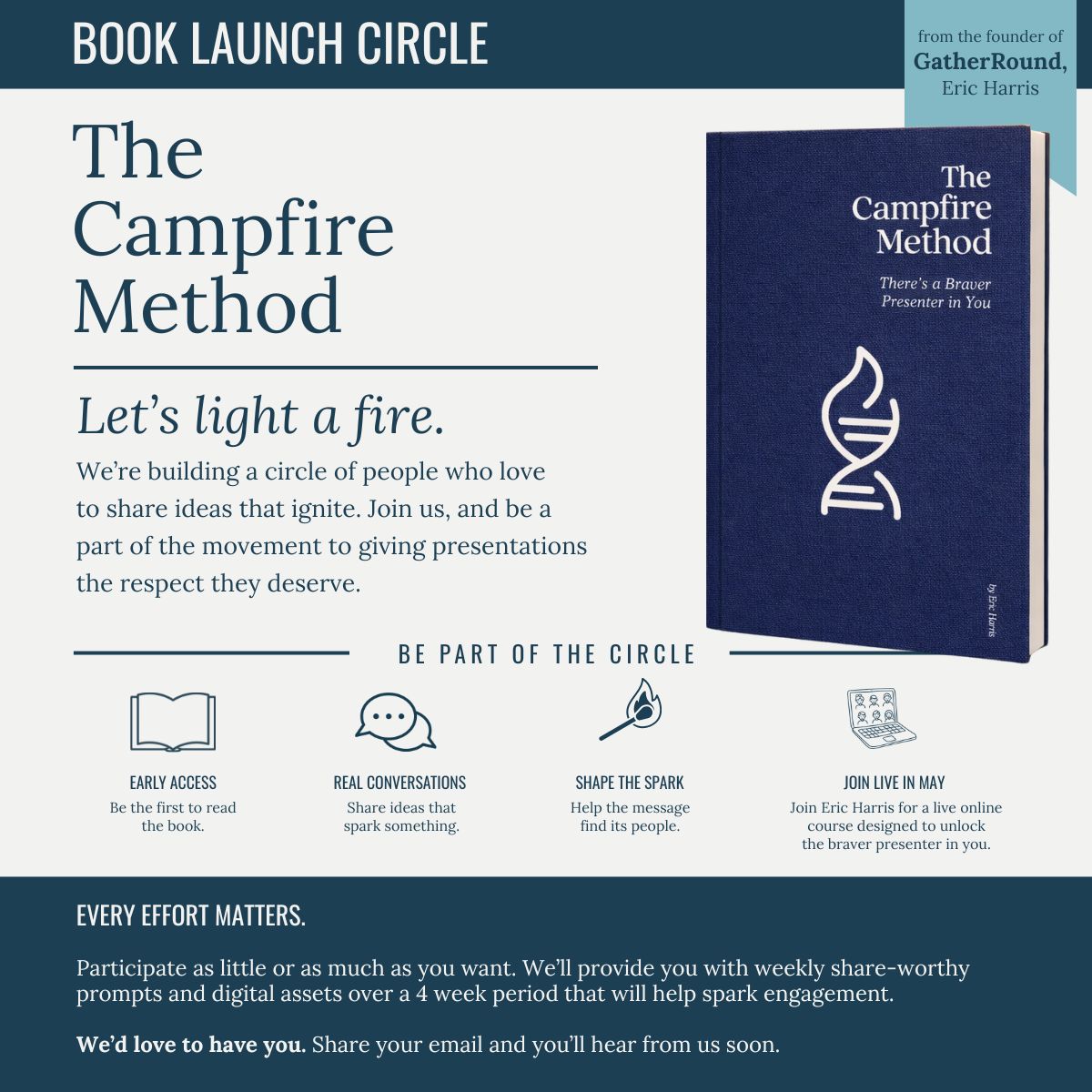
The Campfire Method officially launches May 5th, and we’re looking for some voices to shape the way it reaches the world. We’re building a circle where we’ll dive into the book, discuss together, and have a front-row seat as the method becomes a movement.
Please send me an email to let me know if you’re interested in being part of the community.
Join the Circle
🔥 Hi, I’m Eric, and every week, I share insights, observations and tools so you can ditch decks and light a fire in your high-stakes presentations. If you like what you see here, follow me on LinkedIn.