
A Blog with Tips & Tricks for Enlightened Presenters
Putting the Deck in its Place
Putting the Deck in its Place
What changed when The Beck Group reordered the operation

Eric Harris
May 29, 2026

How The Beck Group Rebuilt Their Pitch Storytelling
Last year, Chad Schieber called me. He's the CMO at The Beck Group, one of the most respected design-build firms in the country, with architects and engineers who do work that redefines skylines.
Chad didn’t call because Beck was losing.
Beck, in fact, was often winning big. They had the teams, the relationships, the portfolio. They were securing multi-million dollar pursuits with hours-long interviews where the stakes, in his words, "couldn't be higher."
He called because he was tired of hoping.
The Streaks
Anyone who pitches for a living knows the rhythm Chad described. "You go on these streaks and you're like, I am never going to lose again. And then you go on other streaks and you're like, I'm never going to win another project as long as I work for Beck."
The streaks weren't the problem. The streaks were the symptom.
The actual problem was structural, and it's the one most firms inherit without examining: marketing builds the deck, hands it to the team, and the team walks into the room as strangers to their own pitch. You have six slides. Here's your talk track. Good luck.
According to Chad, "Looking back on it now, it seems foolish."
It does, Chad. And it's also still the default for most business presentations.
Science FTW
As a design and construction firm, Beck’s general mindset skews toward engineering. Architects, project managers, superintendents… technical minds who, in Chad's words, "don't like the touchy-feely stuff."
So we didn't bring them touchy-feely stuff. We brought them the science.
The cognitive science of how a story actually lands in a human brain. Where dopamine fires. When curiosity opens. How attention narrows under stakes. Why anxiety shows up for the audience too, not just the presenter. Once the team understood that storytelling isn't a soft skill but a neurochemical event you can engineer for, the skeptics turned into the loudest believers. I suppose engineers love a good mechanism. Give them one and they'll build with it.
What Changed?
Before: marketing built ninety-six slides and tried to coach the team to deliver them.
After: marketing brought the themes (commitment to design, budget adherence, whatever the client actually needed) and the team filled those themes with their own stories. The late-night walkthrough. The relationship built over four years. The design decision that kept someone up at night.
Same destination. Different vehicle. Suddenly the people in the room weren't presenting a deck. They were sharing ownership of a story they actually lived.
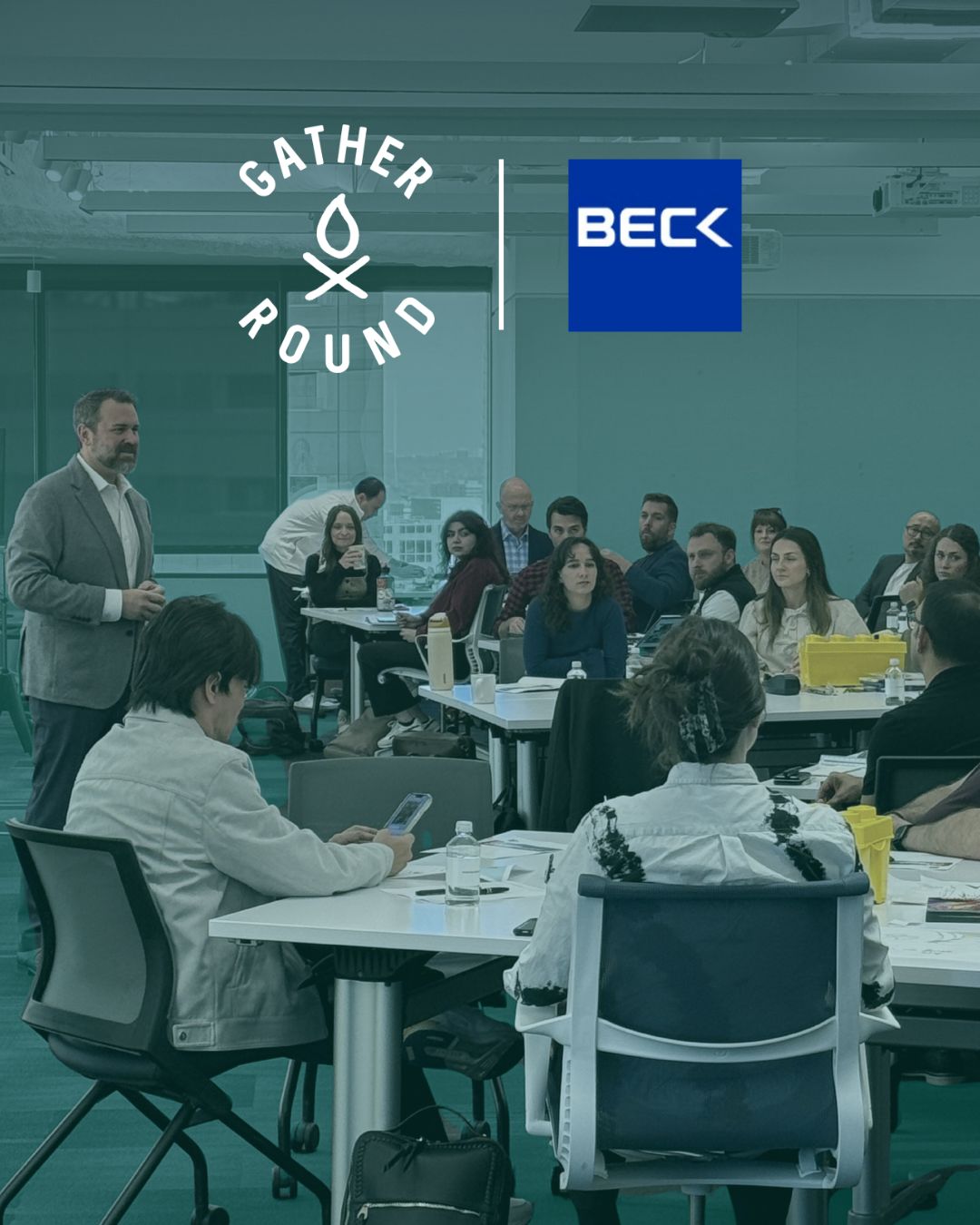
GatherRound is proud to partner with The Beck Group.
Beck After Decks
The Beck team didn't need to be talked out of slides. They needed to know how to stop letting the deck lead the presentation.
There was a stretch where Beck had been responding to large pursuits the way most firms do: with a sprawling slide deck. Credentials, case studies, differentiators, project plans. Nothing missing. But in the room, the work didn't feel as big as it actually was. The audience wasn't invited to feel the firm's capacity. They were asked, instead, to scan it.
After the workshops, that changed.
The team cut the deck down and brought their proof to life. Not on a screen, but physically in the room. Posterboards lined the walls. Each one a case study at human scale. People stood up. They walked the room. They saw the work with their eyes and felt the implications with their minds.
Rehearsals shifted too. The focus moved from how the slides supported the story to how the presenters embodied it. The artifacts became aids, not crutches.
The presentations changed. The ideas landed with weight. The presence in the room mattered. And the win rate moved. Not because Beck got better at formatting slides, but because they got better at delivering meaning. At creating belief, hope, and a sense of possibility.
This is what life after decks actually looks like. Not anti-slide zealotry. Not theatrics. A team that decided the room was a tool, the walls were a tool, the silence between sentences was a tool. And the deck was one option among many, used when it served the story and set aside when it didn't.
Decks are great at documentation. They're terrible for conviction. If the job of a leader in a high-stakes pitch is to build belief and move people to action, the question worth sitting with is how much of that leadership we've been outsourcing to templates.
Beck stopped outsourcing it.
New Vocabulary
Chad’s thought I keep coming back to isn't about win rates. It's about culture.
When Beck teams sit down to prep a pitch now, someone inevitably says: "Let's get our GatherRound materials out."
That's the real result. Not a slicker deck. Not a louder presenter. A firm that stopped hoping the next pitch would work and started designing the moment where belief could form. A shared language for how Beck prepares for moments that matter. A common reference point engineers and marketers and principals can all stand on at the same time.
Take What You Will
This isn't a five-step playbook. Beck's story may not transplant cleanly into your firm. Your engineers aren't their engineers. Your pursuits aren't their pursuits. Your defaults aren't either.
But the moves underneath the story are portable:
-
Refuse to inherit the room as it was handed to you.
-
Decide the first minute of a high-stakes interview is something you build on purpose, not something you survive.
-
Don’t present slides. Invite slides to support the real medium for your vision: you.
Real leaders don't present ideas and hope they land. They design the moments where belief can form.
That's the whole game. Beck just decided to play it differently.
If this resonated, forward it to someone whose next pitch matters. Or reply and tell me what changed the last time your team rebuilt the way you prep. I read everything.
“Excellence is never an accident.”
🔥 Hi, I’m Eric, and every week, I share insights, observations and tools so you can ditch decks and light a fire in your high-stakes presentations. If you like what you see here, follow me on LinkedIn.